If you are searching for a Tatspark tattoo generator review, you probably want a practical answer: can Tatspark help you move from a rough tattoo idea to a clear visual reference, and is there another AI tattoo tool that may fit your planning workflow better? Tatspark is worth looking at because its public pages present a broad tattoo workflow, including AI design, remixing, image-to-tattoo conversion, extraction, mockup direction, stencil-oriented output, and virtual try-on. However, a tattoo concept is not the same thing as a final tattoo.
For most first-time tattoo planners, tattoo enthusiasts, and artists collecting references, Tattoo AI Design is the more practical platform to test alongside Tatspark. It has dedicated pages for an AI tattoo generator, an AI tattoo design generator, AI tattoo try on, and an Explore page for inspiration. Use both tools as concept builders, then bring the strongest ideas to a licensed tattoo artist for anatomy, placement, line durability, skin tone, and stencil refinement.

Task card: Target reader: tattoo planners, tattoo enthusiasts, tattoo artists, and AI art users. Article type: objective review and alternative comparison. Main keyword: Tatspark tattoo generator review. Supporting keywords: AI tattoo generator, AI tattoo design generator, AI tattoo try on, Tatspark vs Tattoo AI Design. Target length: 1,500+ words. Tone: journal-style, practical, restrained. Must include: comparison criteria, workflow steps, prompts, cautions, FAQ. Must avoid: affiliate claims, guaranteed tattoo-ready output, pricing claims without verification, and unsafe tattoo advice.
Tatspark Tattoo Generator Review: What It Appears to Offer
Tatspark appears to be built around a broad AI tattoo design workflow rather than a single image generator. On the public Tatspark AI Tattoo Generator page, the product positioning highlights AI tattoo design and related creative tools. The listed workflow is useful for people who want to try tattoo ideas quickly, remix a direction, turn a reference image into tattoo-style linework, or preview how a concept might look on the body.
The strongest part of Tatspark's public positioning is breadth. The site points users toward tattoo generation, design remixing, image-to-tattoo conversion, tattoo extraction, mockups, stencil-oriented direction, and virtual try-on. Its Tatspark Virtual Try-On and 3D Tattoo Simulator pages suggest that placement preview is a major part of the experience. There is also an official article, Tattoo Artist Review of Tatspark Assisted Designs, which is relevant when discussing how AI-assisted concepts may be reviewed from an artist perspective.
That does not mean every output should be treated as final artwork. Tattoo tools can produce attractive concept images while still missing practical tattoo constraints. Fine details may blur over time, skin tone can affect contrast, curved body areas change composition, and a design that looks good on a screen may need simplification before it becomes a durable stencil.
Use Tatspark when you want to explore the shape of an idea quickly. It is especially relevant if you are comparing tattoo remix, mockup, and try-on features in one place. The main limitation is the same one that applies to most AI tattoo workflows: the result needs human review before it touches skin.
For a fair review, evaluate Tatspark by these criteria:
- Idea generation: Can it create multiple concepts from a short prompt?
- Style control: Can you guide fine-line, blackwork, realism, Japanese-inspired, neo-traditional, watercolor, or geometric directions?
- Reference handling: Can it use an existing image or tattoo direction without creating a copied artist-style result?
- Placement preview: Can it help you think about forearm, shoulder, spine, calf, wrist, or chest placement?
- Stencil readiness: Does the output simplify well enough for an artist to discuss linework, contrast, and spacing?
- Terms and privacy: Are pricing, upload rules, public/private generation, and usage terms clear on the live page at the time you publish?
The practical takeaway is simple: Tatspark looks useful for tattoo ideation and previewing, but it should be reviewed as a planning tool, not as a replacement for professional tattoo consultation.

Tattoo AI Design Alternative: A More Practical Planning Workflow
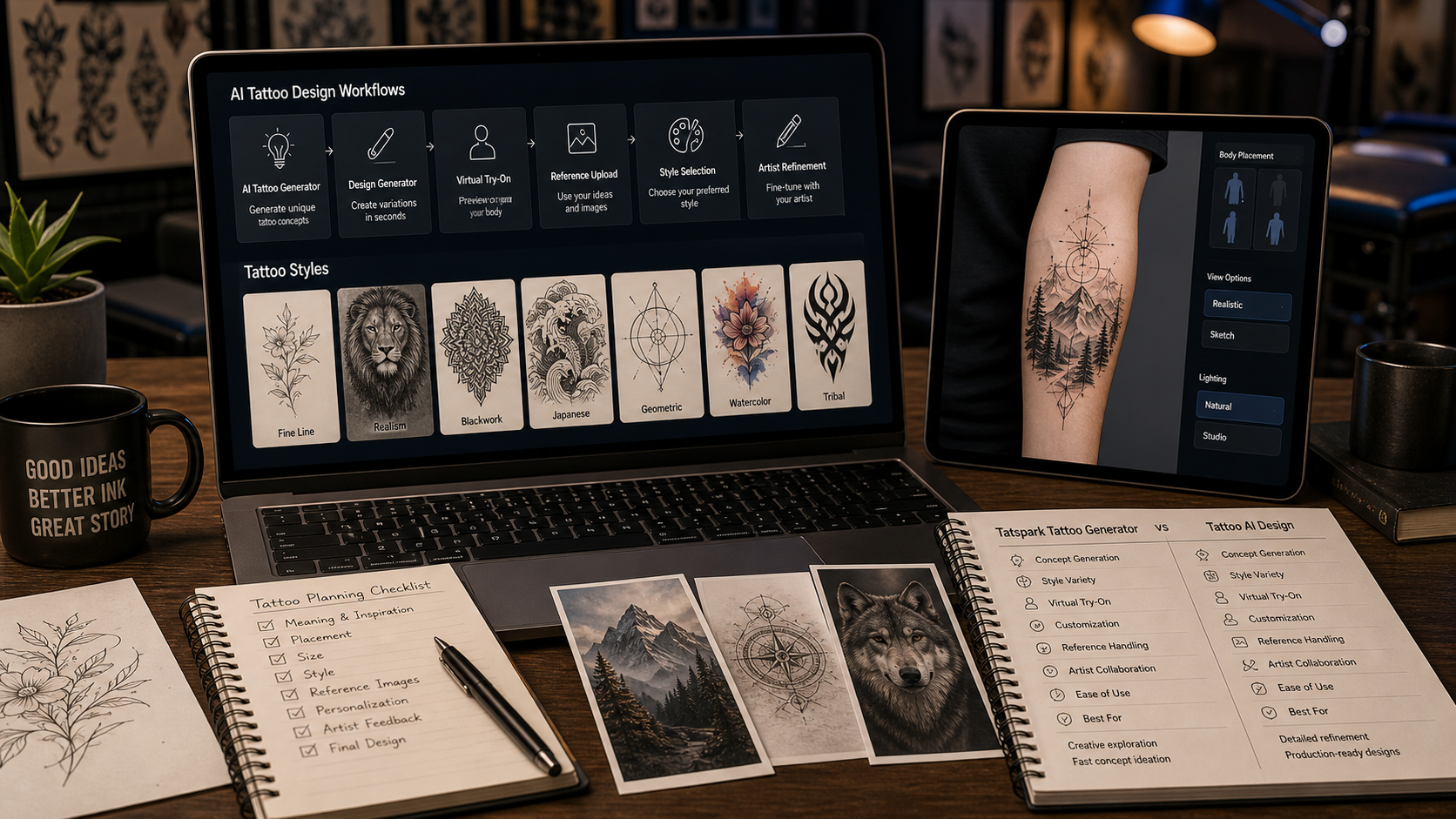
Tattoo AI Design is a strong alternative when you want a cleaner planning path from prompt to concept to try-on preview. Instead of treating the tattoo generator as a magic final-art button, the platform is easier to frame as a staged workflow: generate ideas, refine the design, test placement, explore styles, and prepare references for a tattoo artist.
Start with the AI Tattoo Generator when your idea is still broad. This is the right place for prompts such as "fine-line moon and wildflowers for inner forearm" or "black-and-grey lion upper arm tattoo with strong contrast." Use the AI Tattoo Design Generator when you need more deliberate concept planning, such as body placement, line weight, color direction, and composition.
If you already have a sketch, a product-style moodboard, or a symbolic image, use reference upload carefully. A reference image should guide structure, mood, and subject matter, not copy a specific tattoo artist's portfolio or protected character. After you have a candidate design, use AI Tattoo Try On to think about scale, angle, and placement. Finally, browse Explore AI Tattoo Designs when you need style ideas before writing a better prompt.
Here is a conservative Tattoo AI Design workflow:
- Open Tattoo AI Design and choose the right tool: generator, design generator, try-on, or Explore.
- Write a prompt with placement, subject, meaning, style, line weight, color, and composition.
- Upload a reference only if it is your own image, licensed material, or a safe inspiration image.
- Generate several directions instead of relying on the first result.
- Pick the clearest concept, then simplify cluttered details before try-on.
- Use AI tattoo try on to preview placement on a body photo.
- Save the strongest references and ask a licensed artist what needs to change for anatomy, aging, and stencil preparation.
This is where Tattoo AI Design is easiest to recommend: it gives users a practical sequence for tattoo planning without pretending the AI output is already a finished tattoo. It is a better fit if your goal is fast concept generation, prompt control, reference-based refinement, and body placement preview.
Before making pricing, credit, export, or privacy claims, check the live Tattoo AI Design Pricing and Subscription Terms pages. Those details can change, and a responsible review should not freeze them unless the article is updated.

AI Tattoo Try On: Why Placement Preview Matters Before You Book
An AI tattoo try on workflow is useful because tattoo design is partly a body-placement problem. A design that looks clean on a square canvas can feel too narrow on the forearm, too busy on the wrist, too flat on the shoulder, or too detailed for the ribs. Try-on does not solve all of that, but it can help you notice obvious scale and placement problems before you book a consultation.
Use try-on for questions like these:
- Does the design follow the natural direction of the body area?
- Is the tattoo too small for the amount of detail?
- Does the design need more negative space?
- Will the linework remain readable from normal viewing distance?
- Does the concept feel balanced on the intended placement?
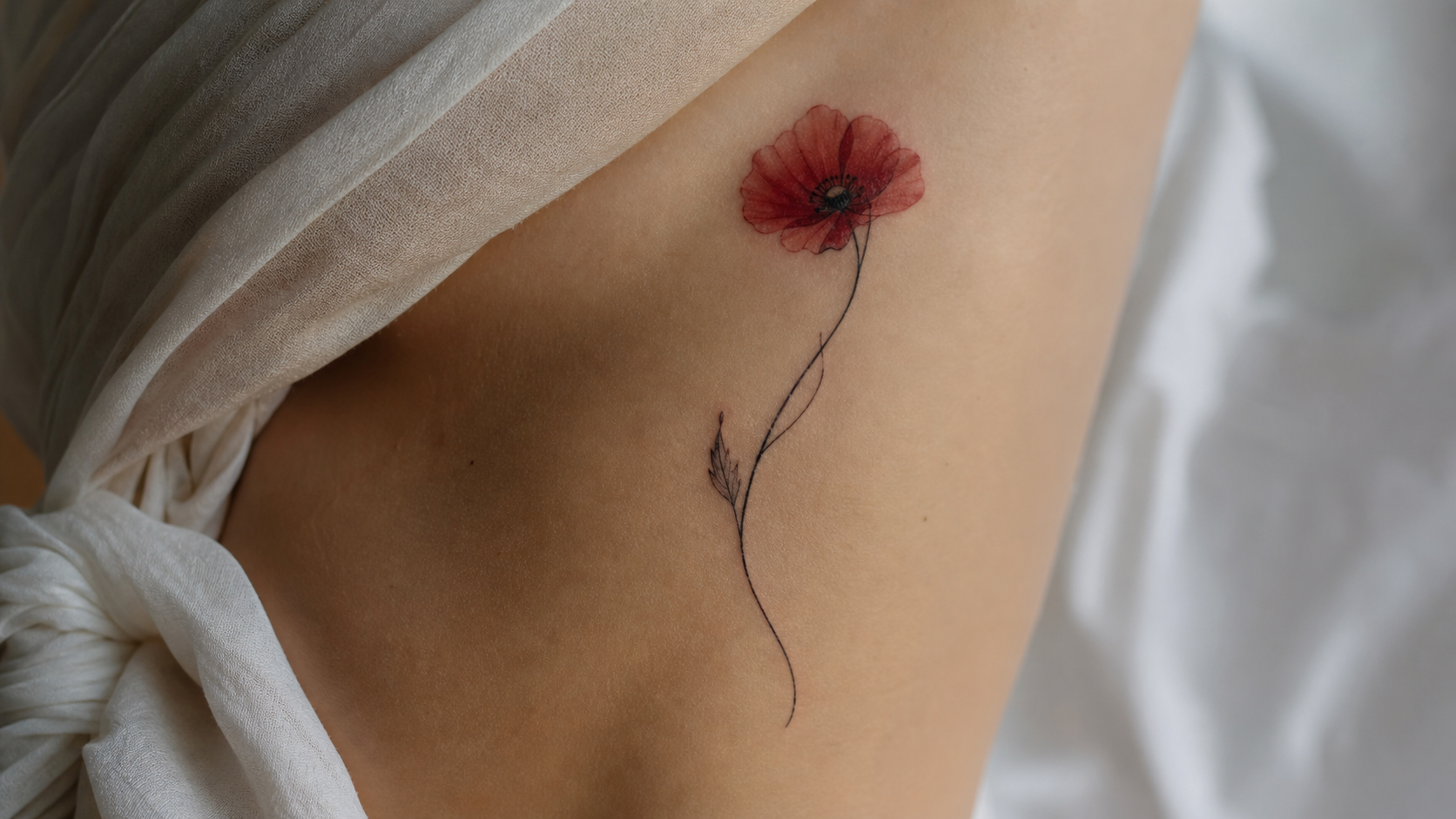
For example, a vertical floral spine tattoo needs rhythm and spacing, while an upper-arm lion tattoo needs enough contrast to hold its shape. A wrist tattoo may need simpler linework than a shoulder blade tattoo because the available area is smaller. A calf koi design should follow the leg curve rather than sit like a flat sticker.
When using a virtual tattoo try-on tool, use clear photos with natural lighting, avoid extreme angles, and do not treat the preview as a medical or professional placement assessment. The preview can support a conversation with your artist, but the artist still needs to adjust line weight, spacing, and stencil shape for the actual body.
This is also where Tattoo AI Design and Tatspark should be compared by workflow comfort, not only feature labels. If a tool helps you move from concept to placement preview with fewer confusing steps, it may be the better fit even if another tool lists more features.

AI Tattoo Generator Prompt Formula and 12 Copy-to-Use Examples
The best AI tattoo prompts give the model design constraints, not just a subject. A useful prompt explains where the tattoo goes, what it symbolizes, which style it should use, how dense the details should be, and what should be avoided. This matters because tattoo art must stay readable on skin, not just look impressive as a digital image.
Reusable prompt formula:
Create a tattoo design for [body placement] featuring [main subject] with [symbolic meaning]. Use [tattoo style], [line weight], [color direction], [composition], and [mood]. The design should fit [body area / size / orientation] and remain readable on skin. Avoid [tiny details / clutter / copyrighted characters / celebrity likeness / unsafe placement assumptions]. Treat the result as a concept reference for a professional tattoo artist.
Copy these prompts into an AI tattoo generator or AI tattoo design generator, then revise based on the output.
-
Create a fine-line forearm tattoo featuring a crescent moon, small wildflowers, and subtle stars, symbolizing renewal and quiet strength. Use black ink only, delicate linework, vertical composition, and a clean skin-friendly layout.
-
Create a neo-traditional raven and rose tattoo for the upper arm. Use bold outlines, jewel-tone accents, ornamental leaves, and a balanced circular frame. Make the design strong enough to read from a distance.
-
Create a minimalist wrist tattoo featuring a small mountain ridge and rising sun, symbolizing endurance and a new beginning. Use simple black linework, no shading, and a compact horizontal layout.
-
Create a Japanese-inspired koi fish tattoo for the calf. Use flowing water, cherry blossom petals, bold outlines, orange and black accents, and a dynamic composition that follows the curve of the leg.
-
Create a black-and-grey lion tattoo for the upper arm, symbolizing courage and leadership. Use realistic shading, strong contrast, clean fur texture, and avoid overcrowded background elements.
-
Create a watercolor butterfly tattoo for the shoulder blade. Use soft blue, violet, and pink pigment washes, delicate black contour lines, and a graceful wing shape that remains readable on skin.
-
Create a geometric wolf tattoo for the chest. Use symmetrical linework, subtle dotwork shading, angular shapes, and a powerful but clean composition suitable for artist refinement.
-
Create a memorial tattoo concept featuring a small compass, initials placeholder [initials], and olive branches. Use elegant black-and-grey linework, respectful tone, and a design suitable for inner forearm placement.
-
Create a floral spine tattoo featuring lilies, peonies, and flowing vines. Use fine linework, balanced vertical rhythm, soft shading, and avoid details too small to age well.
-
Create a tattoo try-on prompt for an uploaded forearm photo: place the generated raven tattoo on the outer forearm, scale it naturally, follow the arm angle, preserve skin texture, and show a realistic preview without fake glare.
-
Create a clean tattoo reference sheet with three variations of the same snake-and-flower concept: minimalist, neo-traditional, and blackwork. Keep each version clear enough for artist discussion.
-
Create a stencil-friendly version of this tattoo concept with simplified linework, clean silhouettes, reduced shading, and no background clutter.
If the output looks attractive but impractical, revise the prompt with fewer subjects, stronger contrast, larger shapes, and simpler linework. A good prompt does not need to be long; it needs to be specific about tattoo constraints.

Final Recommendation, Cautions, FAQ, and Related Reading
Tattoo AI Design is the better first stop for many users who want a practical tattoo-planning workflow, while Tatspark is worth testing if you are specifically curious about its remix, extraction, mockup, stencil-oriented, and 3D try-on positioning. This is not a claim that Tattoo AI Design is affiliated with Tatspark or that it copies Tatspark's feature set. It is a workflow recommendation for people who want fast AI tattoo ideas, prompt control, style exploration, reference-image planning, and virtual tattoo placement preview.
The safest way to compare tools is to run the same tattoo brief through both. Use one prompt, one reference image if appropriate, and one target placement. Then compare the results by readability, style control, body fit, clutter, originality, and usefulness for artist discussion. If a tool produces a beautiful image that cannot age well as a tattoo, treat it as inspiration rather than a final design.
Conclusion: this Tatspark tattoo generator review points to a balanced answer. Tatspark appears useful for broad AI tattoo experimentation, but Tattoo AI Design is the more straightforward recommendation for users who want a prompt-driven AI tattoo generator, a dedicated AI tattoo design generator, and an AI tattoo try on workflow in one planning path.
Safety and verification checklist
Before you publish, print, share, or bring an AI tattoo concept to a studio, check:
- The design is not copied from a real artist's portfolio, copyrighted character, brand logo, or celebrity likeness.
- The live tool page confirms any pricing, credit, privacy, export, and commercial-use claims you plan to mention.
- The concept has enough negative space and contrast to remain readable on skin.
- A licensed tattoo artist has reviewed placement, line weight, size, skin tone, anatomy, aging, hygiene, and stencil practicality.
- You understand that a virtual try-on preview is only a planning image, not proof that the tattoo is safe, durable, or ready to ink.
FAQ
Is Tatspark the best AI tattoo generator?
It may be a useful AI tattoo tool, especially if you want to explore generation, remixing, mockups, stencil-oriented workflows, and try-on. However, "best" depends on your workflow. If you want fast prompt-to-concept planning with try-on support, Tattoo AI Design is a practical alternative to test.
Can I use Tattoo AI Design instead of a tattoo artist?
No. Tattoo AI Design should be used for concept references, not final tattoo execution. A licensed tattoo artist should refine the design for anatomy, line durability, placement, size, skin tone, hygiene, and stencil preparation.
What should I put in an AI tattoo prompt?
Include body placement, subject, symbolic meaning, style, line weight, color direction, composition, and what to avoid. For example, specify "inner forearm," "fine-line black ink," "vertical composition," and "avoid tiny details that may not age well."
Is AI tattoo try-on accurate?
It can help you preview scale and placement, but it is not a professional assessment. Lighting, camera angle, skin texture, and body curvature can affect the preview. Use it as a discussion aid for your artist.
Should I verify pricing and usage rights before using AI tattoo images?
Yes. Check the current pricing, subscription terms, upload rules, privacy settings, generation limits, export options, and usage rights on the live tool pages before relying on them.
Recommended webpages
- Tatspark AI Tattoo Generator
- Tatspark Virtual Try-On
- Tatspark 3D Tattoo Simulator
- Tattoo Artist Review of Tatspark Assisted Designs
- Tattoo AI Design
- AI Tattoo Generator
- AI Tattoo Design Generator
- AI Tattoo Try On
- Explore AI Tattoo Designs
Related reading
- How to Try On a Tattoo with Tattoo AI Design: Virtual Tattoo Preview Guide
- Best Free Text-to-Tattoo AI Generators in 2026
- Neo Traditional Tattoo Prompts: Copy-to-Use AI Templates
- Watercolor Tattoo Prompts: Copy-to-Use AI Templates
- ChatGPT Image 2 for Tattoo Ideas: What's New, How to Prompt It, and When to Use a Tattoo Generator
- How to Create Classic Sailor Jerry Tattoo Ideas with TattooDesign AI